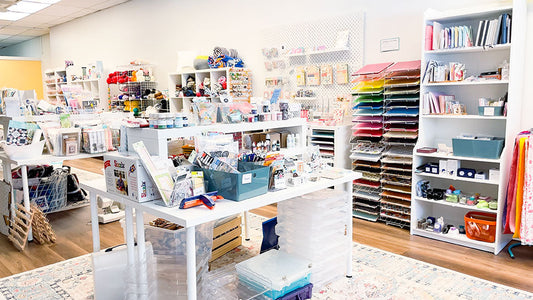

At Hello Art Hatchery, we love it when donations include vintage and antique items – and it’s one of the product categories our customers are most excited to shop.
There’s a natural crossover between arts and crafts and “old things,” whether it’s sewers who seek a level of quality that doesn’t exist in new fabrics and notions, collage artists who want to use authentic ephemera, creatives who are looking for unique items to decorate their studios, or makers who collect classic patterns and designs for inspiration.
Of course, the fun comes with extra work for our team. Figuring out whether something is just old or it’s collectible and how to price it can be tricky. Online chatter often jokes that a thrift store will add “vintage” to any listing to justify a higher price tag.
I’ve been reselling secondhand goods since 2010, and I don’t like to sell anything until I know what it is, when it was made, who made it, and whether it’s truly collectible. I’ve gone down deep rabbit holes with Fisher Price, 1940s glassware, Pyrex, marbles, Little Golden Books, postage stamps, board games, and more – and that research is my favorite part.
All of this to say: when we sell vintage and antiques in our store, we’ve done our homework. But many sellers simply don’t know the terminology, where to look for pricing, or how to spot a reproduction.
That’s why I put this article together: it’s a high-level overview for both resellers and buyers to ensure listings are accurate and we’re all on the same page.
What’s in a Word?
The terms you use in a listing matter – each one signals where an item belongs in the marketplace.
- Vintage: At least 20 years old and less than 100 years old.
- Antique: More than 100 years old.
- Retro: A newer item made in the style of an earlier era.
- Heirloom: An item passed down through a family, often vintage or antique.
- Collectible: Any item – old or new – that is sought after by a group of people.
- Archival: Items with historical significance that should be preserved for future generations.
A Tour of Eras
Knowing the era of a piece helps you describe it accurately – labels like “Victorian” or “Mid-Century” tell a design story buyers recognize. Here’s a quick cheat sheet (date ranges vary by industry and expert):
- Victorian (1837–1901): Romantic, ornate, and highly detailed pieces showcasing craftsmanship and variety.
- Edwardian (1901–1915): Lighter, more delicate styles with florals and airy detailing.
- Arts and Crafts (1860s–1910s): Simple, honest craftsmanship with oak, handwork, and natural motifs.
- Art Nouveau (1890s–early 1900s): Flowing curves and nature-inspired forms, often featuring lilies, dragonflies, and whiplash lines.
- Art Deco (1920s–1930s): Bold geometry, chrome, and glamour shaped by the Jazz Age and machine era.
- Depression Era (1930s–1940s): Mass-produced glassware and affordable household goods, often brightly colored or patterned; includes the well-known “Depression Glass.”
- Mid-Century (1940s–1960s): Streamlined modern classics, with Scandinavian “Danish Modern” influence and Atomic Age flair – boomerangs, starbursts, and sputnik lamps.
- Early Postmodern (1960s–1970s): From psychedelic patterns and boho crafts to shag rugs, avocado kitchens, and wood-paneled basements.
- Postmodern (1970s–1990s): Playful, ironic, and rule-breaking – bright colors, gloss, and geometric Italian “Memphis” style.
Determining Age
Often, you can determine when something was made by identifying its design style within the eras listed above. Not always, though – plenty of new objects are made to look old. Determining an item's age and whether it’s authentic, a reprint, or a reproduction can take some real detective work.
- Copyright Marks: A copyright date isn’t always the slam dunk you’re hoping for – it usually denotes when the copyright was registered, not necessarily when your item was made or printed. Only rely on them if you can confirm with a professional second source, or if the item states explicitly that the date shown correlates.
- Publishing Dates: These often indicate the first publication year, not the printing in your hand. For example, a new printing of The Poky Little Puppy will still show 1942 on the copyright page. Unless the page specifies printing information, verify elsewhere.
- Patent or Trademark Numbers: Many toys, tools, and kitchen items carry U.S. patent or trademark numbers. These can be searched to narrow down when production began.
- Maker’s Marks: Identifying the manufacturer can help you date the item by checking when the company operated, browsing catalogs, or using collector guides and online communities.
- Price Tags or Packaging: Old store labels, packaging styles, or even price stickers can be helpful dating clues.
- Active Listings: Don’t rely on active listings on eBay, Etsy, or similar sites – never assume another seller has done their homework.
- Collector Communities: Facebook groups, online forums, and niche websites often contain detailed catalogs and experienced members who can help identify and date items.
General Identification
When an item has no logos, dates, or marks, these resources can help you identify it so you can begin your research.
- Google Lens: Take clear photos from multiple angles and use Google Lens through the Google app or google.com from any browser. Tap the camera icon to upload your photo, and Lens will scan the web for visually similar items. Results can be mixed, but this is a good first step.
- Reddit: The subreddit r/whatisit has 1.3 million members who crowdsource identifications. Post a picture, and you’ll often get quick, surprisingly accurate answers.
- Pinterest Visual Search: Upload a photo to Pinterest, and it will surface visually similar pins to help narrow your search.
- Facebook Collector Groups: Many niche groups specialize in helping members ID “mystery” items – for instance, “Vintage Toys,” which has 15,000 members. Post clear photos, and you’ll usually get responses from long-time collectors.
- Library Guides & Old Catalogs: Reference books (such as Kovels’ Antiques & Collectibles Price Guide) or digitized catalogs on Archive.org or Google Books can help identify patterns, product lines, and models.
- Specialty Blogs & Online Pattern Libraries: Dedicated websites for specific categories – like Pyrex Passion for glassware or toy collector forums – often include full pattern libraries and product histories.
Adding Value
Before you can put a price on something, it helps to know what counts as a plus and what counts as a minus. These factors can dramatically change value.
- Condition: You’ll need to make a judgment call. Most sellers use words like mint, excellent, very good, good, and fair. The closer an item is to “like new,” the more it’s worth – but look closely at an item and be honest about wear, chips, or repairs.
- Completeness: For items that come with parts, check that everything is there. A Monopoly game missing half the player pieces or a casserole dish without its lid is worth far less than a complete set.
- Wear vs. Damage: Natural age wear (such as patina or slight fading) is acceptable, while chips, cracks, folds, tears, dirt, or repairs typically reduce value.
- Authenticity: Many popular styles have reproductions – an authentic piece will almost always carry more value. Don’t price a mid-century replica like an 18th-century original.
- Packaging: Missing dust jackets on books, sleeves on records, or boxes for toys can slash value. Original packaging, inserts, and manuals almost always increase it.
- Functionality: Mechanical and electric items – like travel alarm clocks, wind-up toys, or lamps – should be tested. Working pieces almost always sell for more than “for parts” or “not working” listings.
- Provenance: Items with a documented history (who owned it, where it came from) often carry a premium. If you have proof that the item is tied to an event or person of note, it can increase the value of that item.
- Category-Specific Grading: Some items – like comic books, marbles, coins, stamps, books, and toys – have strict grading systems or unique factors collectors care about. Make sure you have a good grasp of how they work so you can price accordingly.
Pricing
Once you know what an item is and when it was made, the next step is figuring out what people are actually willing to pay. This is where a lot of resellers go wrong – because it can be easy to get stars in your eyes when you see other sellers asking $75, $100, or $200 for something similar. But active listings don’t really tell you anything. They only show what someone hopes to get.
Sold listings are what matter – because they show what buyers have actually paid.
That said, even sold prices need context. Market saturation matters. Maybe you find a sold listing showing your item sold for $40, but when you check live listings, there are 15 more available for $35. In that case, you’re unlikely to get $40 for yours. Pricing between $25–$30 may be the sweet spot if you want it to move.
To find pricing that reflects real market demand, check a few reliable sources:
- Sold listings on eBay: This is one of the best free tools for realistic comps — but you’ll need to use eBay’s Advanced Search. Go to eBay Advanced Search, enter your item, then check “Sold listings” (and “Completed listings”) to see what buyers actually paid.
- Etsy pricing detective work: Etsy doesn’t make it easy to search sold listings. The best workaround is to use Google Image Search (or reverse image search) to find photos of the same item, then look specifically for results that come from Etsy. Click through to the Etsy listing — if it’s sold and the seller hasn’t chosen to hide the sold price, you’ll be able to see what it sold for.
- Auction archives: Sites like LiveAuctioneers and Invaluable publish past sale results from auction houses. These can be especially helpful for higher-end collectibles and specialty categories.
- Reference books and price guides: Resources like Kovels’ Antiques & Collectibles Price Guide or specialized collector guides (Pyrex pattern guides, toy guides, etc.) can provide helpful ranges and identification details.
- Collector communities: Facebook groups, Reddit threads, and niche forums can offer real-world comps and context, especially for hard-to-price items that don’t sell often.
- WorthPoint (optional for serious resellers): WorthPoint is a paid subscription website that aggregates historical sold prices from eBay and major auction houses. It can be extremely helpful if you resell frequently or specialize in vintage and antiques — but for casual sellers, it may be more than you need.
Pro Tip: Always cross-check more than one source. Pricing isn’t static: condition, completeness, packaging, and even seasonality can shift what a willing buyer will pay.
Final Thoughts
Identifying, dating, and pricing vintage and antique items doesn’t have to feel like a mystery – but it does take patience and a willingness to dig. By using reliable references, checking real sale results, connecting with knowledgeable communities, and being honest about condition and authenticity, you’ll create listings that build trust and help your items find the right buyer.
At its best, reselling isn’t just about money – it’s about getting great items out of basements, attics, and forgotten boxes and back into the world, where someone new can fall in love with them. When sellers do their homework and list items accurately, everyone wins: buyers get what they’re expecting, and sellers build a reputation that keeps people coming back.